Showing posts with label minitrix. Show all posts

February 26, 2012

REVIEW: MiniTrix 12455 DB V300 with Sound


I have heard very few people say good things about sound in N scale.  Well, I'm about to buck the trend.  This V300 has been rock solid, both as a locomotive and as a locomotive with sound.  That is, even if it didn't have sound, I'd be very happy with it, and the sound performance has been flawless.
Is it loud enough: Yes.  It's really loud.  I have the volume set at 150/255 and find it really loud.  I don't want to turn it up more.

Is the sound distorted?   Does is sound bad when turned up?  No!   It sounds good, all the time.

How many sounds:  Start up, Shut down, various rev ranges, wheel squeal, and air brake release, horn and whistle.

The DCC interface from the factory has been trouble free.

So, I've been very happy with this engine.  I guess my only complaint is that when there's dirt on the rails that creates a power interruption you can hear this revving down when it stops, and then if it recovers it revs back up again as it pulls away.   If you're not looking it it, by listening only, you may think something peculiar is going on, but it makes sense.  If the alternative is it coming to a dead and silent stop I don't think I can complain much, and as is it's great for spotting trouble on your rails.  

Overall, I'd give this a 9/10.  This locomotive is singularly the reason I continue to believe in N scale sound, and keep rolling the dice looking for similarly good performers.  I've preordered a new Fleischmann 460 with sound which I've read good things about, I just hope it lives up to this.

Here's a video I found on You Tube this will give you a good taste of what this thing sounds like:


From the Manufacturer:
German Federal Railroad (DB) class V 300 general-purpose heavy diesel hydraulic locomotive. Built in 1957 by Krauss-Maffei as the type ML 2200 C'C', remotored in 1959 as the type ML 3000 C'C'. The locomotive looks as it did from 1964 to 1968. Era III.
The locomotive frame is die-cast metal. The locomotive has a digital decoder for DCC, Selectrix, and conventional operation. It also has a sound effects circuit with many operating sounds, diesel motor, horn sounds, blower motors, and others. The locomotive has a 5-pole motor with 2 flywheels. 4 axles powered. Traction tires. The headlights and marker lights are LED's and can be controlled digitally. The engineer's cabs have interior details in relief. The locomotive has a close coupler mechanism. Length over the buffers 127 mm / 5".


Digital version for DCC and Selectrix, with sound functions.

December 2, 2011

Minitrix 12619: BR Class 58


This was a Christmas present from my wife in 2010.  It is a very smooth performer, one of my best running locomotives.   It starts very reliably and can crawl along with the best of them. The DCC install was a very simple plug and play job, once some small screws are located under the tender.  The headlights are under powered, it is hard to see the illumination, even in a dark environment.  The rear lights are very clear however.  I did contemplate opening this up and looking for trouble with the front lights but all the mechanism is in the boiler, (the tender houses the decoder only), so I decided not to press my luck.  The parts diagram makes clear that there's an awful lot going on in there. and this is no simple plastic shell diesel body.  If you look back a few posts you'll see a silly video I made in which this engine is featured prominently.  

The German class 58 was built in 1920, taken out of service in 1953.  It does not really belong on my Swiss layout, but it'f of the right period and region so it's not too far off either.  


The manufacturer says: Locomotive and tender made of diecast metal. High efficiency motor with flywheel. Close coupling between locomotive and tender. Motor and gear drive in the boiler. Digital connection in tender.  5 axles powered through side rods, 2 traction tires.


June 5, 2011

REVIEW: Trix CE 6/8 Swiss Crocodile 12413

Swiss Federal Railways class Ce 6/8


This is my first locomotive.  This is the reason I picked the Gotthard line as my subject.  The availability of this one model set in motion many years of activity, and there shall be many more to come.   This engine is articulated, it bends, so on a curve it literally curves with the line.  Take a look at the wheels, the pushrods, this engine seems to bridge the gap between the steam and modern eras.  Once warmed up this engine is a good runner, though the small end wheels can be finicky about bad track or switches.

The SX decoder in here has the stink of yesterday's technology to it- not very customizable, not many speed steps, but it also is the best option I've had thus far.  Roco also makes a Swiss crocodile, I have it, and theirs can take an NEM 651 6 pin decoder (on a harness) but it's ridiculously hard to install.  See my future post on this.  I cannot imagine why Trix and Fleishmann do not offer a DCC crocodile today, I know I'd snap one up, as would many others.


The manufacturer says:


Built starting in 1926. World famous electric heavy freight locomotive type, known as The Crocodile. 


Model: Era III, comes with built-in Selectrix Decoder, motor with bell-shaped armature, 6 axles powered, 4 traction tires. Length over buffers 125 mm.

A specially heavy, powerful locomotive able to master steep grades on a curving line was needed for freight service on the Gotthard route. Locomotives were developed in the classes Be 6/8 III and Ce 6/8 III.  The articulated design of these units fulfilled the long-standing requirement for trouble-free transport of freight over the Gotthard.


REVIEW: Trix AM 4/4 12518


This engine is special to me.   It was produced in a limited run in 2005, it has a factory installed selectrix decoder and I got mine from a shop in Switzerland after an odd flurry of emails made possible by Google translate.  It is a supremely smooth runner, it's solid, heavy, and reeks of quality.  

Update 1/10/15: one of the drive axels has lost its gear!  The result is the gear mechanism is unbalanced and so the locomotive simply will not run.   I'm deeply saddened, as this was a favourite.   I bought a dead DC Minitrix v200 off of eBay hoping to scavenge it for parts but it was mechanically different.   I looked up the pro on the Minitrix web site and they have no stock, so unless one of you can point me in the right direction I think this engine is retired.


The manufacturer says:
Swiss Federal Railways class Am 4/4, B-B wheel arrangement. Built starting in 1953 as the class V 200.0 for the German Federal Railroad 


Use: Medium and heavy express trains and fast passenger trains. 


Model: Era IV. Die-cast metal body and frame. • Powerful can motor (with bell-shaped armature) with a flywheel • Digital connector • close coupler mechanism Headlight / marker light changeover, 4 axles powered, 2 traction tires Length over the buffers 115 mm / 4-1/2". 


This model is being produced only in 2005 in a one-time series.


The fact that the German Federal Railroad retired the class 220 did not automatically mean the end of this successful class. Many of these locomotives were acquired by other railroads and overhauled for new uses, including track laying work in Saudi Arabia and in Switzerland, where the class 220 was used for an even longer period of time.

REVIEW: Minitrix Bavarian S 3/6 #12259


I say:

This is a very pretty locomotive but I cannot recommend it.    It's operational characteristics are very poor.  I want this to be excellent, I wish this was my favorite, but it just does not work well.   The audio fails.  It produces random sounds more often than not.   When it work, it does not last.   Run this train for  a while and sooner or later the audio will go horribly wrong.  Reset CV 910 to 1 to fix the issue, but only for a while, and only for the forward running sounds.  Unreliable.  Reversing sounds seem truncated as well.  Sometimes the reversing movement is jittery too.  It's very pretty, and it cost a pretty penny, it's a real shame that it's one really cool feature does not work well.   I suggest you avoid the sound equipped model, and I say this as someone who loves DCC sound.   It's not worth the grief in this case.

I probably should send it back, but the last time I had a defect issue with a Trix train it took a year to get the engine returned, so I'm not inclined to go through that hassle again.


I found this thread on a German language board discussing issues with this model:


2/4/12 UPDATE: I've sent this back to Trix for repairs.  It's worth it, otherwise this is just a very pricy paperweight.  Will let you all know how it goes.

1/10/15 UPDATE:  Wow!  It been three years and today I finally have closure.  I just heard from the shop that the factory has lost it!  Well, not a huge sunrise, given the timeline, but here's the good news:  the factory issued a credit to the shop and the shop then to me.   So, while I lost what was doubtlessly my most attractive locomotive, bar none, I did get the please of it for some months, and now I get to spend that money again.   Yes, it's certainly inconvenient that it went wrong and I do miss it and probably would have replaced it with the same were it still available, but I feel both the store and factory have done the right thing given the circumstance.  The store is www.eurorailhobbies.com and I entirely recommend them to anyone in North America interested in continental trains.   

So, it's been less then 24 hours, has the money already burnt a hole in my pocket?   You bet!  I've just ordered the Minitrix SBB RAM TEE 4 car rail set, with factory DCC and sound!   Hopefully this unit will have a happier life then my last Trix factory sound loco.   Somewhat worrying is the fact that both are of the same generation of had ware, but I hope my poor lost 3/6 was just an anomaly.


The manufacturer says:

Prototype: Royal Bavarian State Railroad (K.Bay.Sts.B.) class S 3/6 express locomotive. Early production run with a streamlined engineer's cab and gas lighting. Used for fast passenger trains, express trains, and cross-border long distance trains. Era I.

Model: The locomotive and tender are constructed of die-cast metal. The locomotive has a powerful motor with a bell-shaped armature and a flywheel. The motor and the gear drive are built into the locomotive. 3 axles powered. Traction tires. The locomotive has a digital decoder for DCC, Selectrix, and conventional operation, built into the tender. The sound effects circuit with a speaker is also built into the tender. The headlights change over with the direction of travel and There is a close coupling between the locomotive and the tender. Length over the buffers 134 mm / 5-1/4".

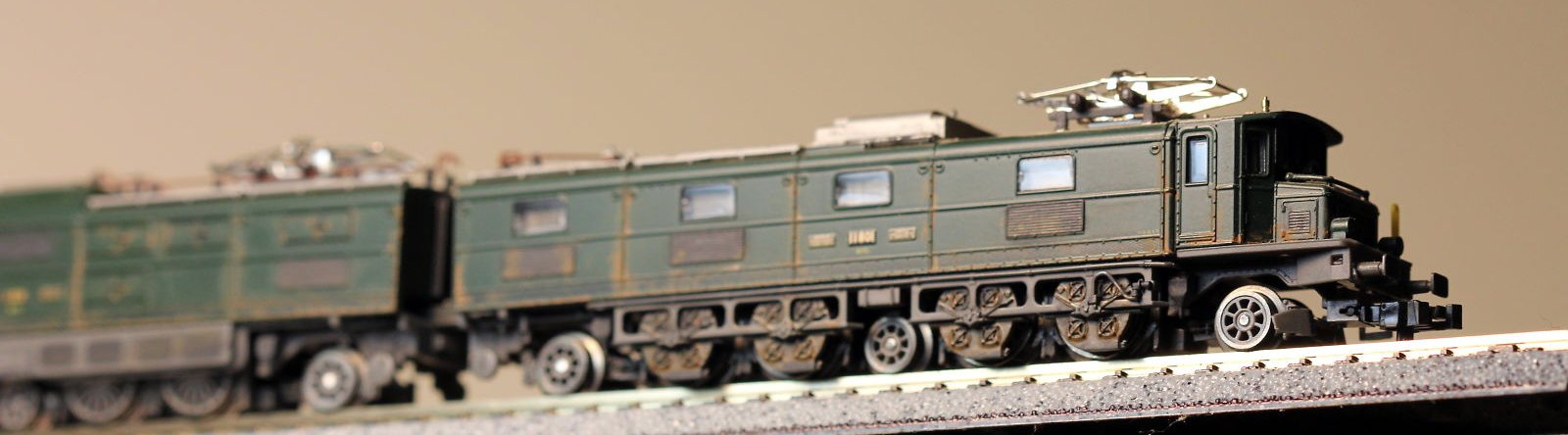
REVIEW: MiniTrix AE 8/14 #12426


With so many wheels, this locomotive seems to have issues on switches and poor track.  It's a bit finicky.  It has lots of pull however, being two locomotives permanently paired together.  The DCC install was easy, a standard NEW 6 pin plugs right in.  Electrical details on the roof look great, as does the external transmission mechanism and all the windows.  Overall, this locomotive has great presence on the layout.  I recommend it, provided you're confident in your layout build quality.  It runs flawlessly on my layout now, but only after much careful debugging.  In some ways owning this locomotive serves a forcing function, in that it's a trouble spot detector!  

Mechanically it's a little noisy, but that seems fitting for it's subject.  

The images below show weathering, as applied by me. 


The manufacturer says:
Swiss Federal Railways (SBB) class Ae 8/14. Built starting in 1931. Used for heavy freight trains on the Gotthard route.


The rail lines in Switzerland with their grades, tunnels, bridges, and curves are a special challenge for the locomotives that travel over them. Mastering the 240 kilometer / 150 mile Gotthard line in demanded extraordinarily powerful locomotives over the years. The Crocodile freight locomotive became famous on this line but the largest and most powerful locomotives were the class AE 8/14 electric locomotives. They were developed in the 1930s just for the demanding requirements of this steeply graded line. Each of these double locomotives had a weight of 240 metric tons. The 8 traction motors for the locomotive gave a starting tractive effort of 50 metric tons and an hourly output of 7,500 horsepower that was transmitted by the proven Buchli drive system from the Ae 4/7.


The locomotive has a die-cast metal frame, with a digital connector, one motor for each locomotive half, 8 powered axles, a close coupling between both locomotive halves and a close coupler mechanism at both ends. Length over the buffers 212 mm / 8-3/8".


UPDATE 1/10/15:  this locomotive is one of two that I own that constantly derails on my layout.  It has trouble with points, the small running wheels on either end go off very easily, I suspect because there is very little weight keeping them down on my thin code 55 rail.   I hope to once again slowly debug all the issues I've apparently introduced with my ballasting but I must say this locomotive is quite a pain.   Still, I love how it looks!